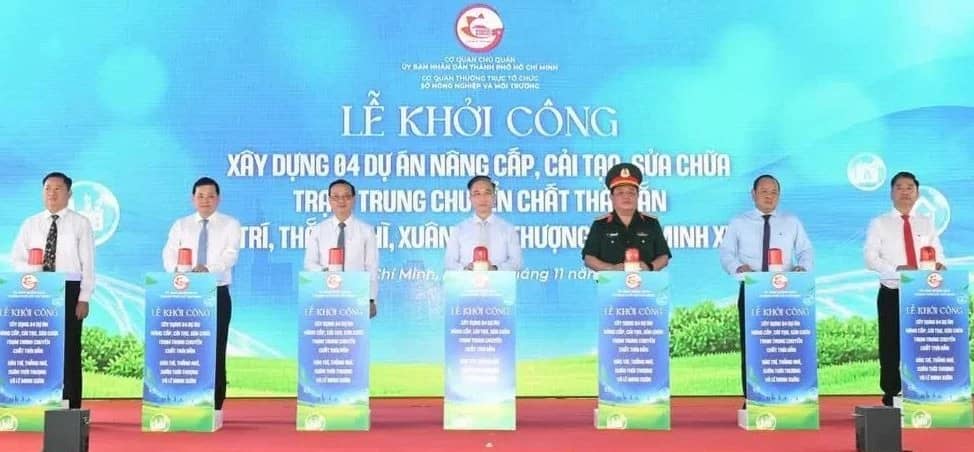
HCMC People's Committee started construction on 4 projects to upgrade, renovate, repair waste transfer stations Đào Trí, Thắng Nhì, Xuân Thới Thượng and Lê Minh Xuân on the morning of 27/11/2026. Total investment over 1.8 trillion VND.
Mr. Bùi Minh Thạnh, Vice Chairman of HCMC People's Committee, said the city has over 14 million people and is requiring increasingly high standards for technical infrastructure, environmental protection and modern urban management. Synchronous investment in collection, transfer, transport and treatment of waste is not only solving immediate requirements but also a strategic task in the green transition and sustainable development process.
The investor committed to shortening construction time to about 12-15 months without compromising quality, safety and environment. During construction, waste collection, transfer and transport activities must be maintained continuously, avoiding waste accumulation.
Mr. Nguyễn Toàn Thắng, Director of HCMC Department of Agriculture and Environment, said the city collects, transports and treats nearly 15,000 tons of household waste every day. Transfer stations are a critical link in the waste management system. The city currently has 39 waste transfer stations (27 in area 1, 4 in area 2, 8 in area 3). Some stations still operate as open collection points, causing odor, leachate or overload, directly affecting residents' lives and urban environmental quality.
By orientation toward 2050, the city develops a network of 86 transfer stations; area 1 has 48 stations, area 2 has 21 stations and area 3 has 17 stations. In the 2026 investment plan, the city plans to start 8 transfer stations; in November 2026, 4 stations Đào Trí, Xuân Thới Thượng, Lê Minh Xuân and Thắng Nhì are deployed with total investment about 1.806 trillion VND. Phase 2027-2030, HCMC continues to prepare investment for 50 transfer stations with total estimated investment about 16.87 trillion VND.
Especially, these 4 projects took only about 5 months to prepare since the investment policy decision at the end of June 2026. During this time, procedures regarding investment dossiers, capital sources, current land status, assets and temporary transfer plans were handled simultaneously by agencies and units to create conditions for construction.
After completion, stations will operate in the direction of transfer, compressed waste in enclosed form, strengthening odor and leachate control and transport activities. According to Department of Agriculture and Environment leadership, the significance of the projects lies not only in infrastructure upgrading but more importantly in gradually overcoming environmental shortcomings in residential areas, improving public service quality and efficiency of household solid waste management.