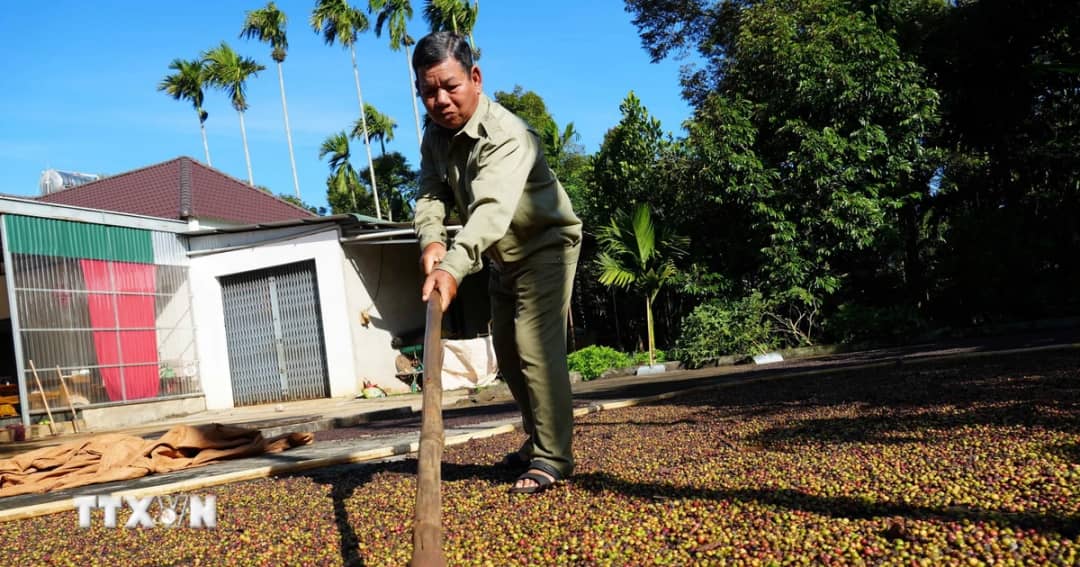
Domestic coffee prices recovered last week, rising 800-1,000 VND/kg in the Central Highlands, reaching 72,000-73,000 VND/kg. Specifically, in Đắk Lắk and Gia Lai, purchase prices rose 900 VND/kg to 72,700 VND/kg. In Lâm Đồng, prices rose 800-1,000 VND/kg, fluctuating in the range of 72,700-73,000 VND/kg.
On the global market, Robusta coffee on ICE London saw a strong recovery session after hitting a three-year low of 2,709 USD/ton. Closing the week, the Robusta contract for January 2027 rose 3.12% (equivalent to 89 USD/ton) to 2,946 USD/ton.
Traders said the Robusta recovery is supported by reports that Vietnamese farmers - the world's largest Robusta producer - intend to hold stocks and limit sales if prices continue to fall sharply. As of November 22, only about 15-16% of Vietnam's new coffee crop has been harvested. Unfavorable weather in growing regions is also slowing the delivery of new supply to the market.
Technical factors also support prices as certified Robusta stocks on ICE London as of November 26 fell to 5,689 lots (down 15.6% from the beginning of the month), along with investment funds closing short positions after a record accumulation period.
Regarding the rice market, domestically in An Giang, most rice prices were flat after rising well in previous weeks. Fresh Đài Thơm 8 rice fluctuates at 7,500-7,600 VND, equivalent to last weekend; OM 18 is around 7,600-7,800 VND/kg; IR 50404 remains at 6,800-6,900 VND/kg. Other varieties such as OM 5451 from 7,500-7,600 VND/kg; OM 34 at 6,800-7,000 VND/kg, both up 200 VND/kg.
Rice paddy prices fluctuated slightly in some varieties: CL 555 at 9,400-9,450 VND/kg; IR 50404 fluctuating at 9,100-9,200 VND/kg, down 200 VND/kg; OM 5451 from 11,310-11,200 VND/kg, also down 200 VND/kg. Others remain flat: Đài Thơm 8 at 9,200-9,400 VND/kg; OM 18 fluctuating 8,700-8,850 VND/kg.
For exports, 5% broken rice prices remain flat at 475-485 USD/ton. A trader in Ho Chi Minh City said India's planned rice export tax has not yet directly affected Vietnamese rice prices, but traders are closely watching New Delhi's next steps. Meanwhile, Vietnam's domestic paddy rice supply is currently at a low level.
In India, rice export prices have risen to the highest level since March 2025 (over 19 months ago). Specifically, 5% broken parboiled rice is offered at 396-401 USD/ton, up from 394-398 USD/ton last week. India's 5% broken white rice also rose to 398-403 USD/ton.
A trader in Mumbai at a trading company said the strengthening rupee is forcing exporters to raise selling prices to protect margins, while foreign demand remains positive. The Indian government is considering export taxes on some rice varieties to boost domestic supply and cool domestic consumer prices.
In Thailand, 5% broken rice prices spiked to 520 USD/ton before cooling to 510 USD/ton, the highest level since October 17, 2024. Last week, this variety was in the range of 505-510 USD/ton.
A trader in Bangkok said prices rose mainly because exporters aggressively bought to cover short positions, along with the arrival of ships to pick up orders from the Philippines and Japan. In addition, the main fragrant rice harvest in Northeast Thailand has begun, but yields are expected to decline due to recent flooding.
Regarding the US grain market, grain prices on the Chicago Board of Trade (CBOT) all recovered in the November 27 trading session - a shortened session after the Thanksgiving holiday - driven by the strong rally in the soybean market.
At the close, the soybean contract for January 2027 rose sharply 22.25 cents to 12,6625 USD/bushel, recording the highest price in a month. The wheat contract for March 2027 rose 3.5 cents, closing at 5.91 USD/bushel.
The soybean market's price momentum comes from the strong recovery of the Brazilian real after President Luiz Inacio Lula da Silva appointed a banker favored by investors as the next Finance Minister. US soybean export demand remains stable with weekly sales of 755,800 tons, plus an export order of 132,000 tons to the Netherlands for the 2026/2027 crop year.
The soybean price breakthrough also received momentum from expectations of increased demand from the European Union (EU) to meet new anti-deforestation regulations effective late December.
For wheat, prices edged up in a thin session after the holiday thanks to positive spillover from soybeans. Traders continue to closely monitor escalation in the Black Sea region. Ukrainian Foreign Minister Andrii Sybiha said the country has proposed a ceasefire in the Black Sea to ensure food exports.
Meanwhile, the Russian Foreign Ministry accused Latvia of creating artificial barriers to Russian grain transit, while the Murmansk port in Russia's Arctic region announced it has signed a grain export contract of 600,000 tons through September 2027.