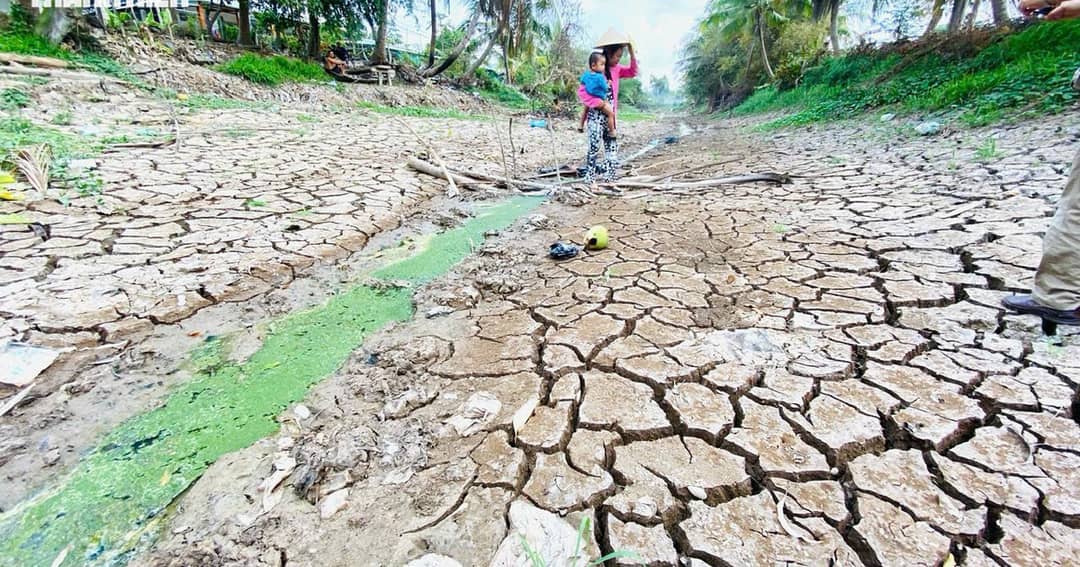
December marks the start of the dry season in the Mekong Delta, but this year's flood peaked and receded earlier than the multi-year average. As of late November, total water flow at Kratie station (Cambodia) was down 26% compared to the same period in 2025 and down 6% compared to the multi-year average. Water level at this station is 3.36m lower than the same period in 2025 and 1.25m lower than the multi-year average.
Super El Nino has left water levels in Mekong hydropower reservoirs low. Reservoirs in the upper reaches in China are at about 77.7%, and lower reaches at about 75% of useful storage. Total regulatable water for the 2026-2027 dry season from reservoirs is about 49.19 billion cubic meters, down about 10 billion cubic meters from 2025.
SIWRR forecasts that from December 2026, water flow at Kratie will be low to very low. Consequently, salinity intrusion may affect production early. In coastal Mekong Delta, the 4ppt salinity front may penetrate 25-30km deep in early December, and another 10km deeper to 35-40km by month-end. From January to April 2027, on Mekong branches the 4ppt front may penetrate 55-75km deep.
The Winter-Spring rice crop in the Mekong Delta has entered the critical stage, and water supply depends entirely on regulation by upstream hydropower dams. Operation of these dams could cause adverse impacts and push salinity deeper than forecast.
SIWRP compares this year's drought and salinity as more severe than the 2015-2016 dry season and comparable to the 2019-2020 dry season. Localities must proactively store water for the Winter-Spring and flower crops, and especially for forest fire prevention.