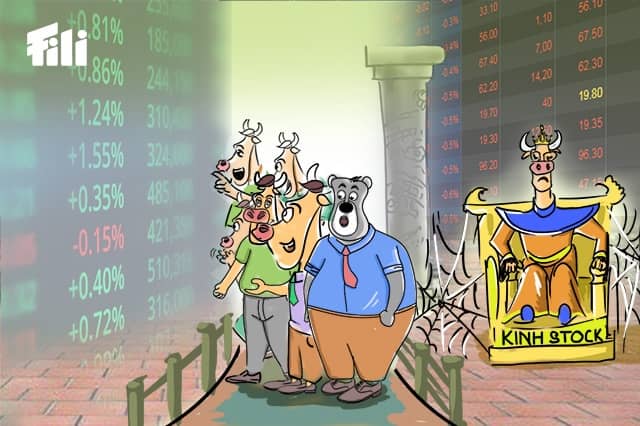
VN-Index lost nearly 35 points last week despite recovering in the final session. Analysts remain cautious about weak buying power, but some see investment opportunities as stock prices have fallen sharply.
According to SHS Securities, most stocks have returned to reasonably valued levels after a prolonged decline since May. Investors may consider increasing weight in leading companies with solid business fundamentals.
TPS Securities reported VN-Index ended the week with a P/E of 10.47x, lower than 99% of trading sessions over the past 10 years. However, TPS forecasts the index may retest the 1,618-1,630 point zone and fluctuate between 1,618-1,680 points next week. If it closes below 1,618 points, VN-Index risks falling to 1,578-1,590 points. Conversely, breaking above 1,680 points with volume higher than the 20-session average could push the index to 1,698-1,712 points.
SSV Securities advises investors to stay on the sidelines while the downtrend remains strong, watching the 1,600 point level closely.
Yuanta Vietnam Securities maintains its recommended allocation of 80% cash and 20% stocks, advising against large bottom-fishing. Stocks with good business prospects in power, retail, and select individual companies can be watched for buying when prices stabilize.
PHS Securities recommends using the rebound to sell weak stocks, especially in high-margin accounts. If the index loses 1,635 points, it risks falling to 1,590-1,600 points.
VPBank Securities noted foreign investors net bought more than 600 billion VND across the market, a positive sign. VN-Index may continue to recover partially toward the 1,680-1,700 point zone.
BIDV Securities (BSC) said the session's gain of more than 24 points occurred with matching value 19% lower than the 20-session average, mainly a rebound after a sharp decline rather than a trend reversal. VN-Index may need more time to consolidate around 1,640-1,660 points before choosing its next direction.
Asean Securities (Aseansc) advises short-term investors to maintain moderate weight, avoid chasing gains, and focus on stocks with individual stories such as state capital divestment, market upgrade, and economic development policies.