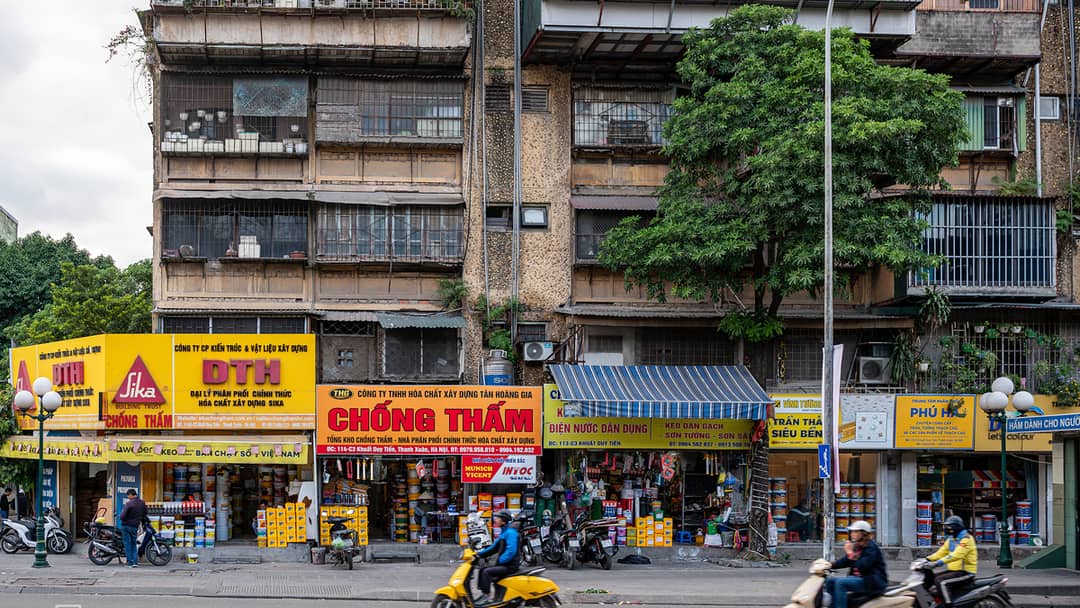
The revised Housing Law takes effect on 1/7/2027 and defines old apartments as projects invested and built from 1994 or earlier. This cutoff date is used to determine renovation and reconstruction policies among different types of apartment buildings.
For apartments built in 1994 or earlier, owners are not allowed to self-fund renovation. They may choose one of four compensation forms: resettlement housing, social housing, cash, or land use rights. Compared with the current Housing Law, compensation forms are expanded, adding social housing and land use rights. Owners of old apartments continue to be compensated under coefficient K as at present.
Under Decree 94, coefficient K for floor 1 apartments ranges from 1 to 2 times the usable area recorded in the red book. Coefficient K for floors 2 and above is lower, at 1 to 1.5 times the usable area.
For apartments built after 1994, owners have the right to continue using the area with the apartment building to self-renovate and rebuild through cost contribution. This amount is agreed to be paid in a lump sum or according to project progress after apartment handover.
If owners do not want to rebuild the apartment, they may agree to transfer rights and obligations to another entity to carry out renovation. This is a difference compared with the 2023 Housing Law.
Under the new Law, if owners do not contribute money or do not transfer land use rights to another entity, they will be compensated for the value of land use rights with the apartment building. This value is determined based on the proportion of land use rights at the time of demolition. Afterwards, owners must hand over the land back to the State for transfer to the project investor for renovation and reconstruction.
The Law also stipulates that if planning continues to allow apartment reconstruction, owners are resettled on-site unless they have no demand. If planning no longer designates apartments, owners are compensated, supported, and resettled according to land law.
The Law sets out four cases where apartments must be demolished: damage due to fire, explosion, natural disasters; structures at risk of collapse requiring emergency relocation; local damage, technical infrastructure systems not ensuring safety, or one of the main structures (foundation, column, wall, beam, slab) failing to meet normal usage requirements, requiring comprehensive renovation.
To attract investors to renovate and rebuild old apartments, the new Law offers many incentives such as exemption from land use fees and land rent. Investors are allowed to do business with remaining apartment and commercial areas after arranging resettlement, while being exempt from social housing obligations. They also receive support from local budgets for site clearance and infrastructure construction, and enjoy tax and credit incentives.