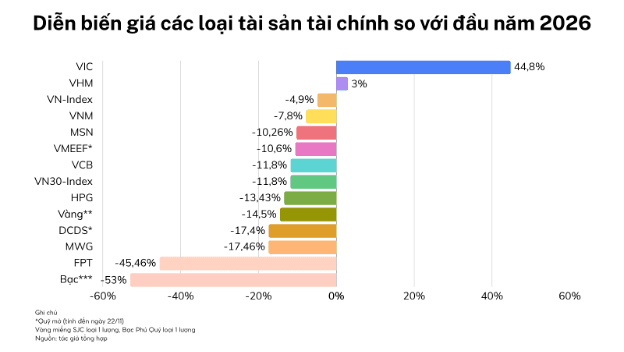
At the end of 2026, Vietnam's gold, stocks, and real estate all stalled while cash waited for opportunities ahead of expected interest rate cuts.
In November alone, VN-Index fell nearly 3%, and compared to the start of the year, the index dropped 5%. If weakness continues, the market could close three consecutive months of declines. The correction affected many sectors and stocks, from large-cap to small-cap.
Domestic gold prices fell sharply following global trends. SJC gold bars fell to around 133.5 million VND/tael (sell) and 128.5 million VND/tael (buy). Gold has fallen about 30% from its peak. Silver bars traded around 1.3-1.5 million VND/tael, down 70-80% from the peak.
The real estate market also stalled. The absorption rate of new supply in the quarter reached only 45%, down 24 percentage points from the previous quarter and 2 percentage points lower than the same period in 2025. In the secondary market, liquidity weakened as average condo prices fell quarter-on-quarter and were flat year-on-year.
"Pressure from global capital is narrowing as US 10-year Treasury yields exceeded 5.2%. Domestically, high interest rates make the stock channel face fierce competition," Fmarket open-end fund distribution platform commented.
Crypto assets also fell sharply. Bitcoin dropped to 55,251.6 USD last weekend, the lowest since September 2024. At a recovery to 60,000 USD, the cryptocurrency lost more than half its value from the all-time high set in October 2025.
In mid-year, banks offered deposit rates at a high level of around 9%/year, but are now gradually reducing. At the end of October, the cash ratio of DCDS, an open-end fund under Dragon Capital, was 5.3%, down from 15.5% at the end of September. Similarly, VinaCapital's VMEEF open-end fund reduced its weight from 15% to 10%.