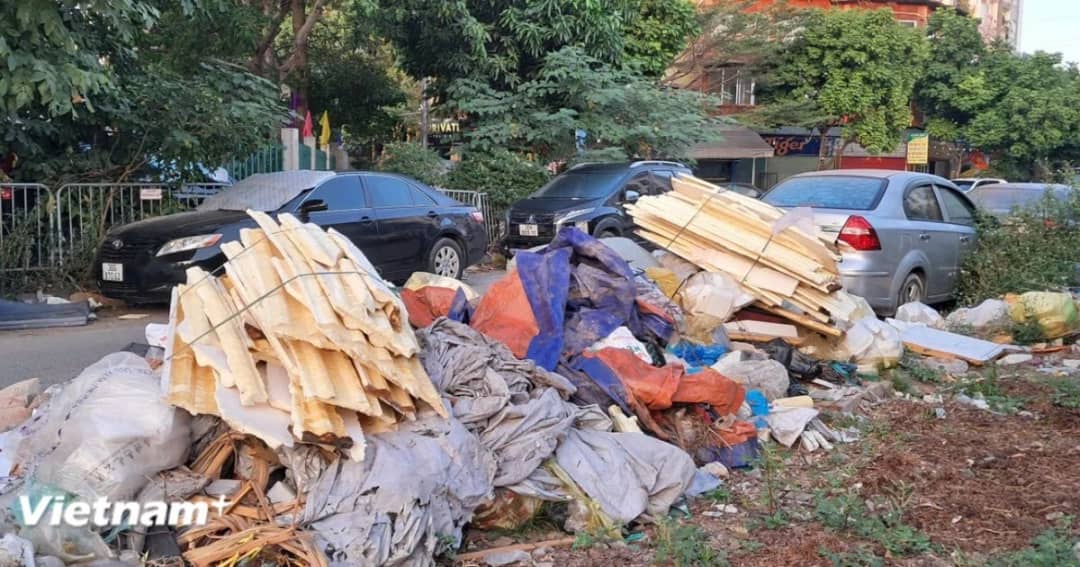
The Law amending and supplementing several articles of the Law on Environmental Protection was just passed by the XVI National Assembly at its second session, stipulating that household solid waste is managed according to the principle of sorting, prioritizing reuse and recycling, reducing the volume of waste to be treated, landfilling, and suitability with technical infrastructure. Provincial People's Committees stipulate sorting according to a roadmap set by the Government, ensuring at least two groups, including a group of waste with potential for reuse and recycling.
A representative of the Department of Environment said that, under the Law, the circular economy is promoted through policies encouraging, incentivizing, and supporting tax, fees, green credit, green bonds, green procurement, and green consumption in accordance with legal provisions; requiring ministries, sectors, and localities to integrate circular economy content within their management scope.
The Law also supplements provisions on the management of materials from waste recycling activities. Specifically, recycled materials meeting standards and technical regulations on raw materials, fuel, and materials under the law on product and commodity quality are managed as products and goods. The State prioritizes the use of recycled materials in projects and tasks using the state budget; assigns the Government to stipulate subjects and roadmap for implementing the rate of recycled materials in products and goods.
Provisions on waste management are also adjusted in the direction of creating conditions for the reuse of soil, stone, concrete, bricks, sand, mud, and inert materials from construction activities for specific purposes; clarifying the management of excavated soil and rock, tailings from mineral exploitation and processing, and domestic slag.
Regarding Extended Producer Responsibility (EPR), a representative of the Department of Environment said the amended Law stipulates that organizations and individuals may implement recycling responsibility through self-collection for recycling or transfer to appropriate organizations; hire units to carry out collection and recycling; authorize intermediary organizations or apply other forms as prescribed by the Government.
The Law no longer stipulates the form of financial contribution to the Vietnam Environmental Protection Fund to implement recycling responsibility; at the same time, it allows transferring unfulfilled recycling responsibility to subsequent years as prescribed by the Government.
Regarding financial contributions to support waste treatment, the Law excludes products and packaging subject to environmental protection tax to avoid overlapping financial obligations; supplements content supporting the upgrading of infrastructure and equipment for collection, sorting, and transportation of household solid waste in difficult and especially difficult areas.
The Law amending and supplementing several articles of the Law on Environmental Protection also supplements requirements to update electronic data on waste import activities; stipulates that escrow or bank guarantee must be carried out before waste is unloaded at the port for cases imported via seaports or before waste is imported into Vietnam for other cases.