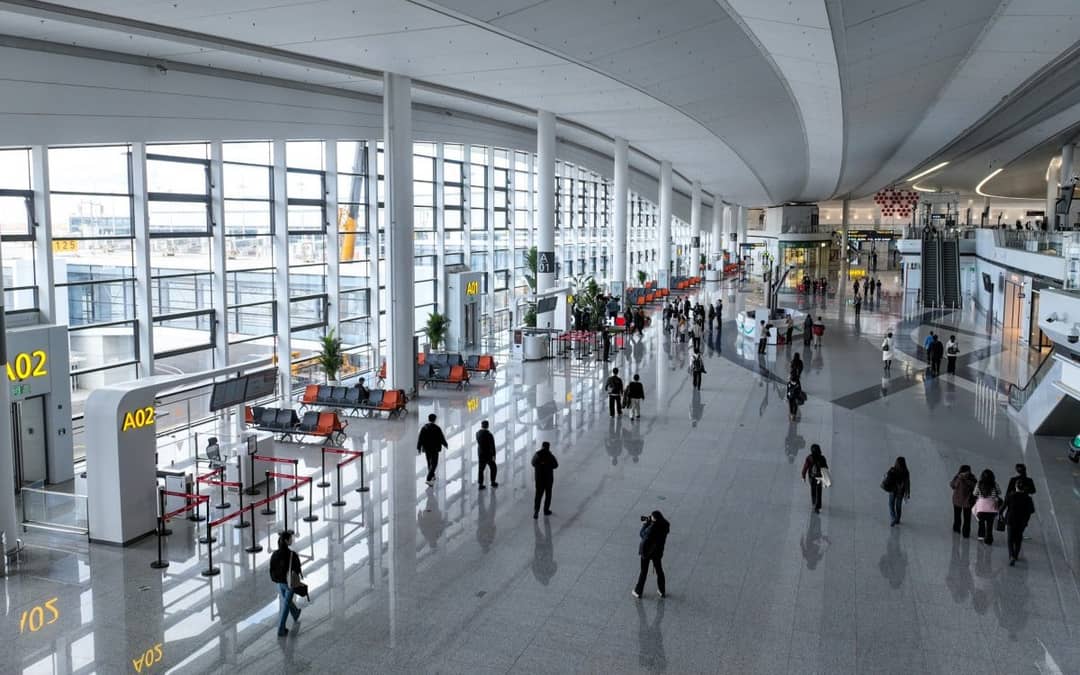
China officially launched Hohhot Shengle International Airport at the capital of Inner Mongolia on 26/11. The airport replaces the old Hohhot Baita International Airport, which was constrained by surrounding urban development and lack of expansion space.
Total investment is 23.11 billion RMB, equivalent to 81.8 trillion VND. The airport has 2 runways measuring 3,400 meters and 3,800 meters respectively, with parking stands for 130 aircraft.
The terminal covers 320,000 square meters, larger than the combined area of terminals T1 and T2 of Noi Bai International Airport (Hanoi) at 315,000 square meters.
Design capacity is 28 million passengers, 320,000 tonnes of cargo and 244,000 commercial takeoff and landing movements per year.
According to independent aviation analyst Li Hanming, the airport is 410 km from Beijing, close enough to receive large aircraft such as Airbus A350 and Boeing 747 diverted from the capital when bad weather or poor visibility disrupts operations. Other airports at similar distances from Beijing are too small to handle such aircraft types.
The new facility is described as "one of the key alternative airports in the Beijing-Tianjin-Hebei airport cluster". Beijing's two international airports handled nearly 788,000 flight movements last year.
The airport also aims to strengthen regional connectivity and support cross-border trade. People's Daily described Shengle Airport as a "key transport hub" for China's Belt and Road Initiative, linking more than 150 partner economies into a China-centric trade network.