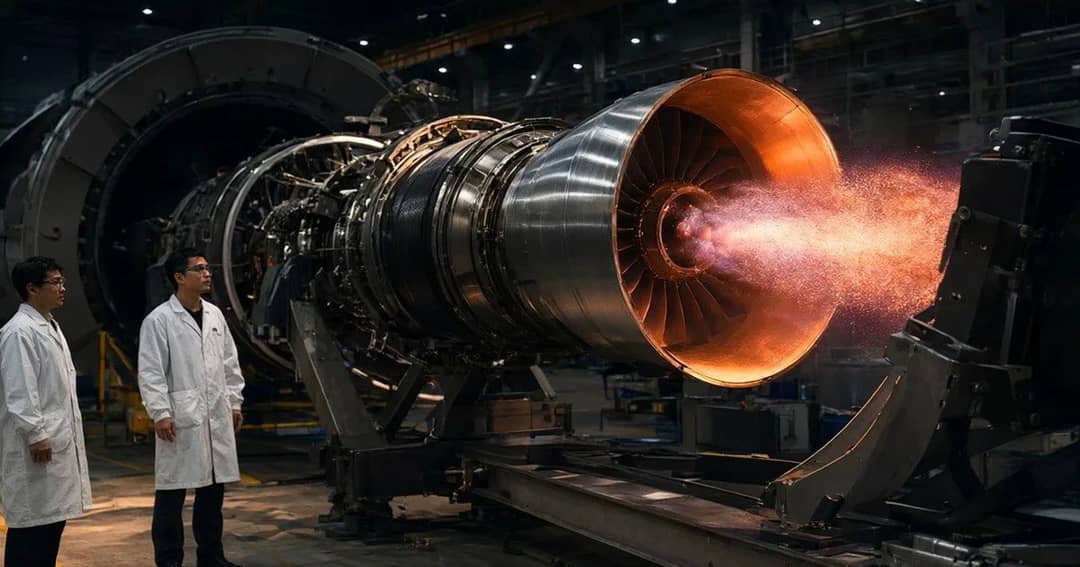
A research team from Nanjing University of Aeronautics and Astronautics in China, led by Sun Haijun, has completed the world's first ground static test of a prototype turbojet engine with an afterburner using metal powder instead of conventional aviation jet fuel.
Principle of operation: the afterburner plays an important role when aircraft need rapid acceleration, heavy takeoff, or breaking the sound barrier, and has appeared on classic supersonic models such as Concorde and early Tu-144 models before switching to RD-36-51A engines. The biggest drawback of traditional afterburners is very high fuel consumption in a short time, limiting thrust augmentation and system thermal durability.
Switching to metal powder highlights energy density advantages. Powdered aluminum provides chemical energy of 84 MJ/l, nearly 2.5 times higher than 34 MJ/l of conventional jet fuel. Metal powder can also participate in oxidation reactions with CO2 and water vapor available in the hot exhaust gas stream. By taking advantage of these compounds as oxidizing environments, the combustion process becomes stronger and more complete, creating potential to increase temperature, exhaust gas velocity, and overall thrust.
Using solid material in the form of fine particles not only optimizes efficiency per liter of volume but also promises to extend afterburner operating time instead of just a short burst.
The research team spent more than four years handling three core problems: precise powder flow control, stable multi-phase ignition activation, and keeping the flame from being extinguished in high-speed airflow. Engineers designed a powder injection fuel delivery system combined with flow regulation mechanism and an aerodynamic cavity flame holder. This aerodynamic cavity creates a hot gas recirculation zone right in the combustion zone, acting as an anchor to keep the flame stable before the high-speed airflow sweeps through the afterburner.
Ground static test results confirmed the prototype operated according to initial design parameters, demonstrating the feasibility of coordinating powder metering, ignition, and flame holding in harsh aerodynamic environments.
Prospects: in high-speed aviation, one of the biggest barriers today is the lack of an engine system operating efficiently and uniformly from subsonic to supersonic and hypersonic speeds, especially the Mach 5 threshold and above. The ability to maintain more sustainable afterburning thanks to metal powder is expected to add a crucial link to supersonic aircraft designs and future hypersonic vehicles, making acceleration and maintaining high-speed flight more flexible.
However, experts still need more detailed experimental data because the university has not released specific indicators such as thrust achieved, specific impulse, continuous burn time, exact metal powder composition, or direct performance difference compared to conventional fuel afterburners.
In the next phase, the research team aims to increase prototype thrust, complete an intelligent powder metering control system to automatically adapt to each operating mode, and expand the development test series. These control algorithm and thrust characteristic refinements will be the foundation for the project to transition to more complete test design stages, gradually verifying whether metal powder afterburner technology can move from the laboratory and ground test bench closer to supersonic skies.
Reference: Science
Vietnam Daily