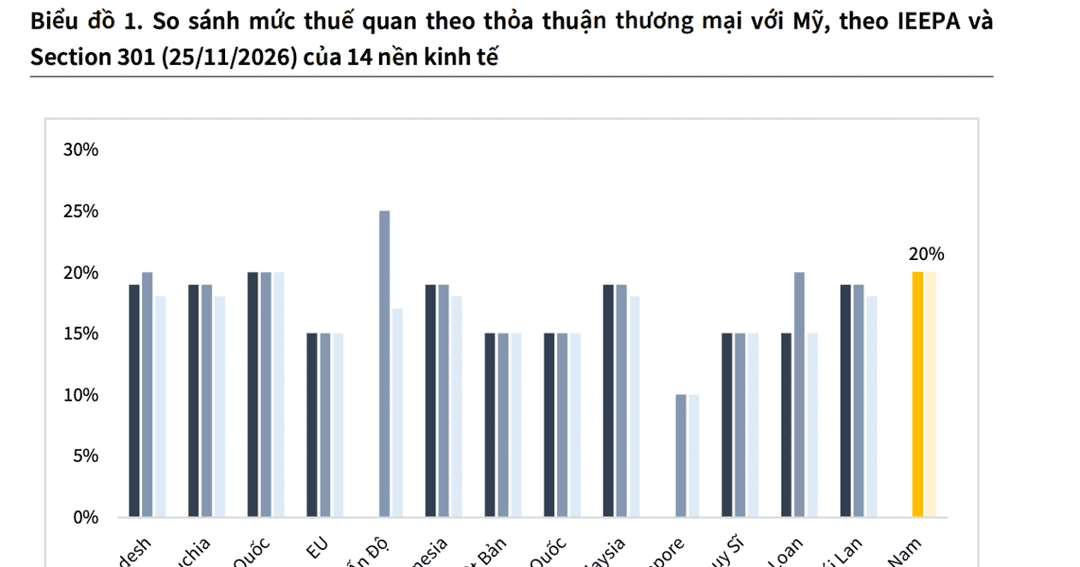
KBSV believes the actual tariff Vietnam faces on US exports is likely 20%, equivalent to the start-of-year level, so it will not significantly change the export outlook. Achieving this rate depends on negotiating a reciprocal trade agreement before the comment deadline of 05/01/2027. In December, Vietnam is invited to the high-level G20 conference in Miami, which KBSV hopes will push negotiations forward.
However, US accusations that Vietnam's currency is undervalued will make it harder for the State Bank of Vietnam to cut interest rates. The central bank will only buy foreign exchange reserves when the interbank exchange rate falls to 25,500 VND/USD.
For the stock market, the final tariff rate is expected to be determined by February 2027 at the earliest. In the short term, impact comes partly from sentiment and reduced expectations for rate cuts. KBSV assesses the impact will be significantly lower than in April 2025, as markets are now better prepared and more adaptable.
According to ABS statistics, in 13 tariff events from 2018–2026, VN-Index fell an average of 1.4% after one session and 0.8% after five sessions. The April 2, 2025 event, when the US announced a 46% reciprocal tariff on Vietnam, caused VN-Index to drop 11.3% after five sessions and reach a maximum decline of about 17%.