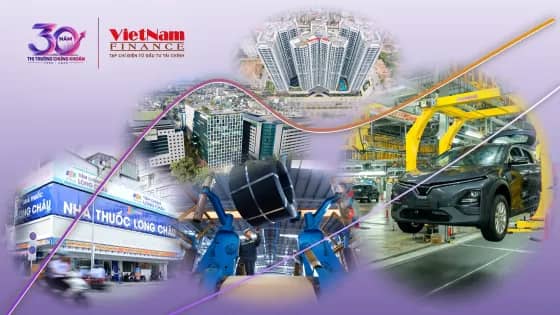
The article analyzes the strategic pivot capability of Vietnamese listed companies through the S-Curve theory and the Ambidextrous Organization model.
Key content:
- FPT Retail (FRT): In 2017–2018, when FPT Shop was generating record profits of hundreds of billions of VND per year, the leadership acquired the Long Châu pharmacy chain with only 4 stores. During 2018–2020, consolidated profit dropped sharply but FRT persisted. By 2021, Long Châu broke even. Now Long Châu has over 2,400 pharmacies, average revenue of 1.1–1.2 billion VND/pharmacy/month, contributing nearly 70% of total revenue (2025 exceeded 50,000 billion VND).
- REE: From 2002, when its M&E segment was booming, REE launched E.Town 1. Now it has the E.Town 1–6 complex with over 180,000 m2 of office space for rent and over 90% occupancy. During 2011–2026, REE used steady cash flow from E.Town to M&A in energy and clean water, which now contributes 85% of net profit.
- Vingroup (VIC): During 2018–2021, Vingroup divested VinMart/VinMart+ to Masan, closed Adayroi, VinPro and discontinued Vsmart to focus on VinFast. In 2022, VinFast killed internal combustion engine vehicles to switch 100% to electric vehicles. In August 2023, VinFast listed on Nasdaq. VinFast now holds 38–40% of the domestic car market for 22 consecutive months.
- Hòa Phát (HPG): In 2007, invested in the Hải Dương integrated steel complex. In 2017, started Dung Quất 1 (6 million tons/year). During 2022–2025, launched Dung Quất 2 (5.6 million tons of HRC), raising total crude steel capacity to over 16 million tons/year.
The article also mentions mistakes when pivoting: entering areas outside core competence (e.g., Tân Tạo with Kiên Lương thermal power) and using short-term debt to finance long-term projects (e.g., Thủy sản Hùng Vương - HVG, Hoàng Anh Gia Lai - HAG).