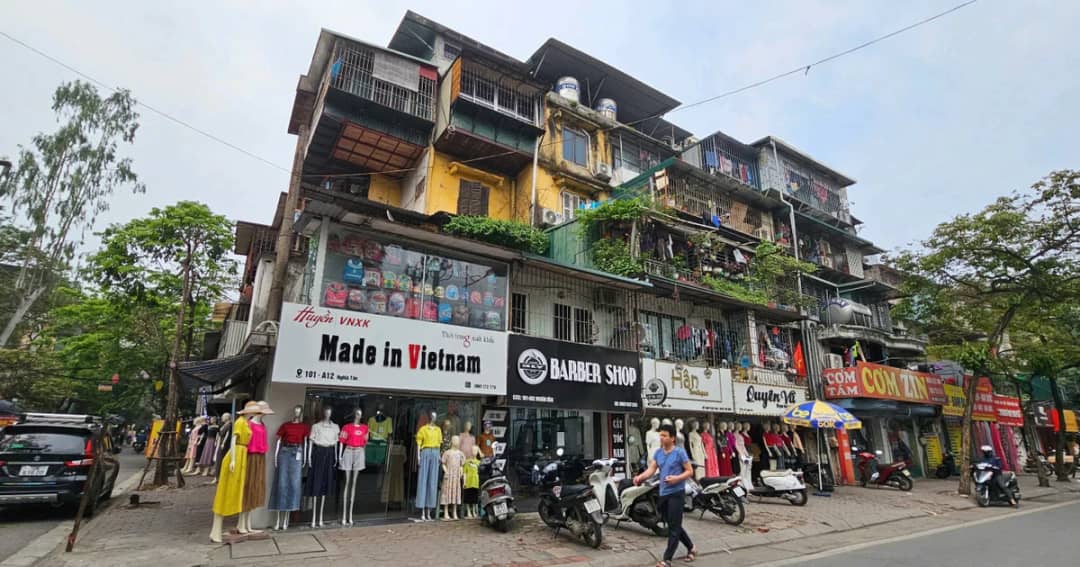
The National Assembly passed the revised Housing Law, effective 1 July 2027, introducing the concept of “old apartments” — buildings invested in and constructed before 1994 — as the basis for compensation and resettlement mechanisms during renovation and reconstruction.
Regarding compensation and resettlement, owners may choose one of four forms: resettlement housing, social housing, cash, or land use rights of equivalent value to resettlement housing. Compensation plans must clearly state coefficient K, land price for compensation if any, value of resettlement housing, difference to be paid, moving costs, and temporary housing support.
Coefficient K currently applied: ground-floor units range 1-2 times the usable area stated in the certificate; units from floor 2 upward are 1-1.5 times usable area. Resettlement housing area must not be lower than the minimum area under national technical standards for apartment buildings.
If land use planning at the site continues apartment construction, residents are resettled on-site. During project implementation, residents needing resettlement via housing, rental, or land use rights are provided temporary accommodation; the agency assigned by the provincial People's Committee or the investor is responsible for arranging housing or paying for residents to rent on their own.
To resolve deadlocks in investor selection, residents still choose investors through apartment owners' meetings. If no selection is made, the provincial People's Committee assigns an investor, instead of leaving projects stalled.
The law also adds build-transfer (BT) contract forms for old apartment renovation and delegates more procedures to localities to shorten project preparation time.
"Renovating old apartments is a social security issue, so the State must maintain a leading role in building mechanisms, policies, organizing planning, coordinating interests, and protecting residents' rights," said KTS Phạm Thanh Tùng, Head of the Office of the Vietnam Association of Architects.