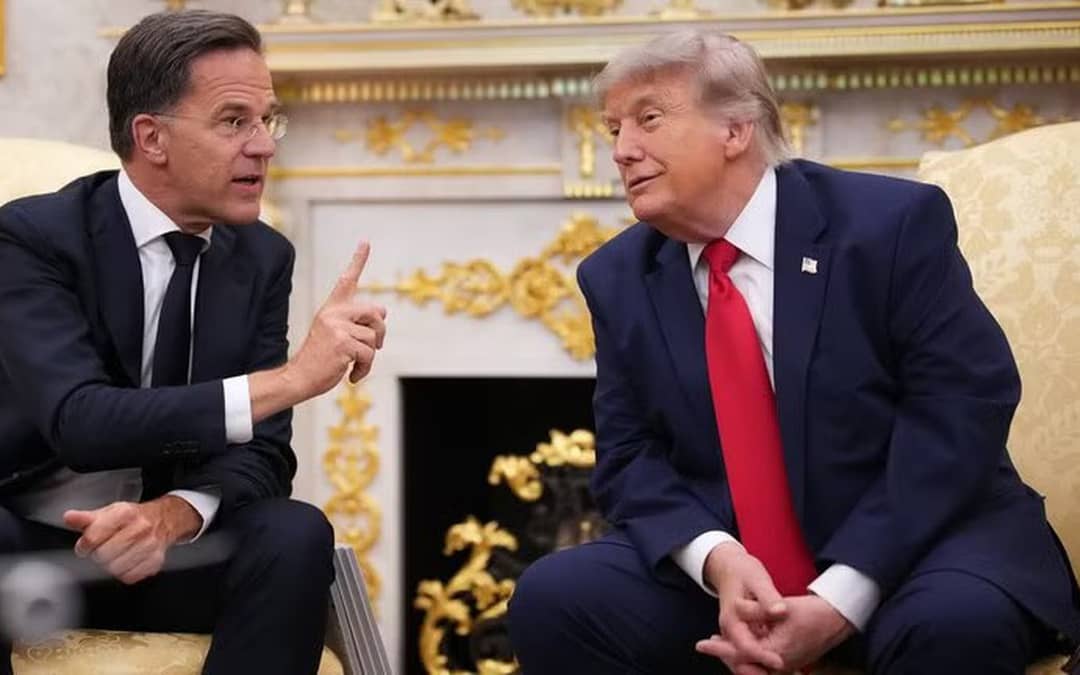
US President Donald Trump has released a revised version of a joint statement on the Ukraine conflict, agreed between him and NATO Secretary General Mark Rutte.
According to Politico, citing an unnamed NATO official, Trump "surprised" Rutte by stating that Ukraine should also avoid "any deliberate or unintentional action to escalate the war". In the original text, the call only targeted Russia.
NATO and the White House both announced the agreed text on the evening of 25/11. However, Trump's post on Truth Social includes several changes, including an addition about efforts to strengthen Western military industrial capacity.
The mention of Ukraine was added to an existing paragraph in the joint statement, which, according to Politico sources, had been formally approved by both sides.
According to Trump's statement, Ukraine also has a responsibility to avoid escalating tensions, issued a few days after Ukraine conducted UAV attacks targeting Russian ships in the Mediterranean and the Baltic Sea. One target was a Russian frigate docked at Benghazi, Libya - a neutral country.
Even Western governments funding Ukraine's war effort have publicly expressed concern about the conflict spreading geographically beyond the front lines.
Previous efforts by Ukrainian President Vladimir Zelensky to escalate the conflict by targeting Russian civilian ships in the Sea of Azov and commercial warehouses faced strong retaliation from Russia. Since then, Russian forces have frequently targeted ships using Ukraine's Black Sea ports, paralyzing the country's export operations.
Even before the escalation, cargo ships traveling to and from Russia's Black Sea ports frequently became targets of UAV attacks, which Russia says were carried out by Ukraine.
The Trump administration confirmed they had warned Zelensky's government not to attack oil tankers participating in Kazakhstan's crude oil exports via Russia.
Zelensky publicly praised the attacks in Libya as a major military success. The campaign was condemned by both of Libya's rival governments as a violation of national sovereignty, taking place less than a week before a key European Council debate on providing additional tens of billions of euros in aid to Ukraine. EU leaders failed to reach an agreement and postponed the decision to December.